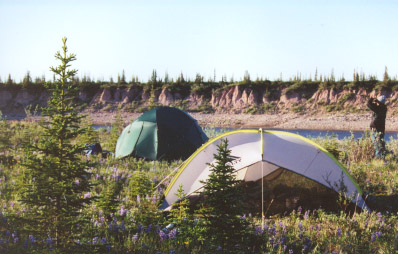
Campsite coordinates: 13 W 057180, 713015.
 After five days of exchanging the important duties of steering and map reading in the stern, a pattern began to emerge. Mo seemed to attract headwinds. We saw more wildlife when I was in the stern. So with Mo in the stern it was no surprise that a northwest wind developed as we followed the river in a generally northerly direction.Several times the wind was directly ahead and strong. I took some water from large waves that splashed in at the bow. We paddled hard and kept watching the bank to gauge our progress--we were barely moving. We took a break and I said, "We could walk faster than we're paddling. We should tow the canoe.""I never heard of that," said Mo. But we tried it and we did indeed make better progress. We found that the best technique was to wrap one of the painters around the handle of the paddle, wedge the paddle against a thwart or seat and then push the canoe ahead and move it closer or away from shore depending on the depth or any obstructions. It was quite easy to move the canoe this way and, to state the obvious; it is why canoeing works in the first place. To push 400 pounds on land would be hard work; but to push a loaded canoe in the water requires almost no effort. The hard work was wading in knee-deep water and finding firm footing; but it was much easier than paddling into a headwind. We came to a place where the deep water was near the shore. So we paddled some more and then, later, pushed the canoe along when the water on our bank got shallower. Mo also tried to keep in the lee of high banks and islands but it didn't not help that much.